
Legal workers in the New York-Newark-Jersey City metropolitan area earned a mean hourly wage of $86.28 and accounted for 1.4% of all local employment in May 2024, according to the U.S. Bureau of Labor Statistics New York wage release. That figure matters less as a salary benchmark than as a warning about where the money goes. Every hour a managing partner spends chasing medical records, formatting exhibits, or returning routine scheduling calls is attorney time spent on administrative work.
Most articles about hiring a legal assistant in NYC stop at pay ranges and generic duties. They miss the operating issue. Hiring support in New York is a capacity-coverage and supervision problem, because the firm has to decide which work can be handed off, who directs it, and what stays with the client's firm.
Your attorneys went to law school to practice law. Ideally, they should occasionally get to do that. Getting them back to legal work requires separating daytime case administration from live client intake, pricing what each hour of coverage really costs, and putting supervision guardrails in place before anyone touches a client file.
That last point is where support models get slippery. Legal judgment stays with the client's firm. Support can handle intake, follow-up, admin, and operations, but it cannot replace the firm's responsibility for legal decisions. A good coverage plan makes that boundary clear on day one, then builds the workflow around it.
Table of Contents
- What a Legal Assistant in NYC Really Does
- Staffing Models and Cost Per Covered Hour
- Why Adding an Assistant Does Not Fix Intake
- The Compliance Checklist Before Anyone Touches a Client File
- How to Vet a Virtual Legal Support Provider
- Confirm the Coverage Gap Before You Hire
What a Legal Assistant in NYC Really Does
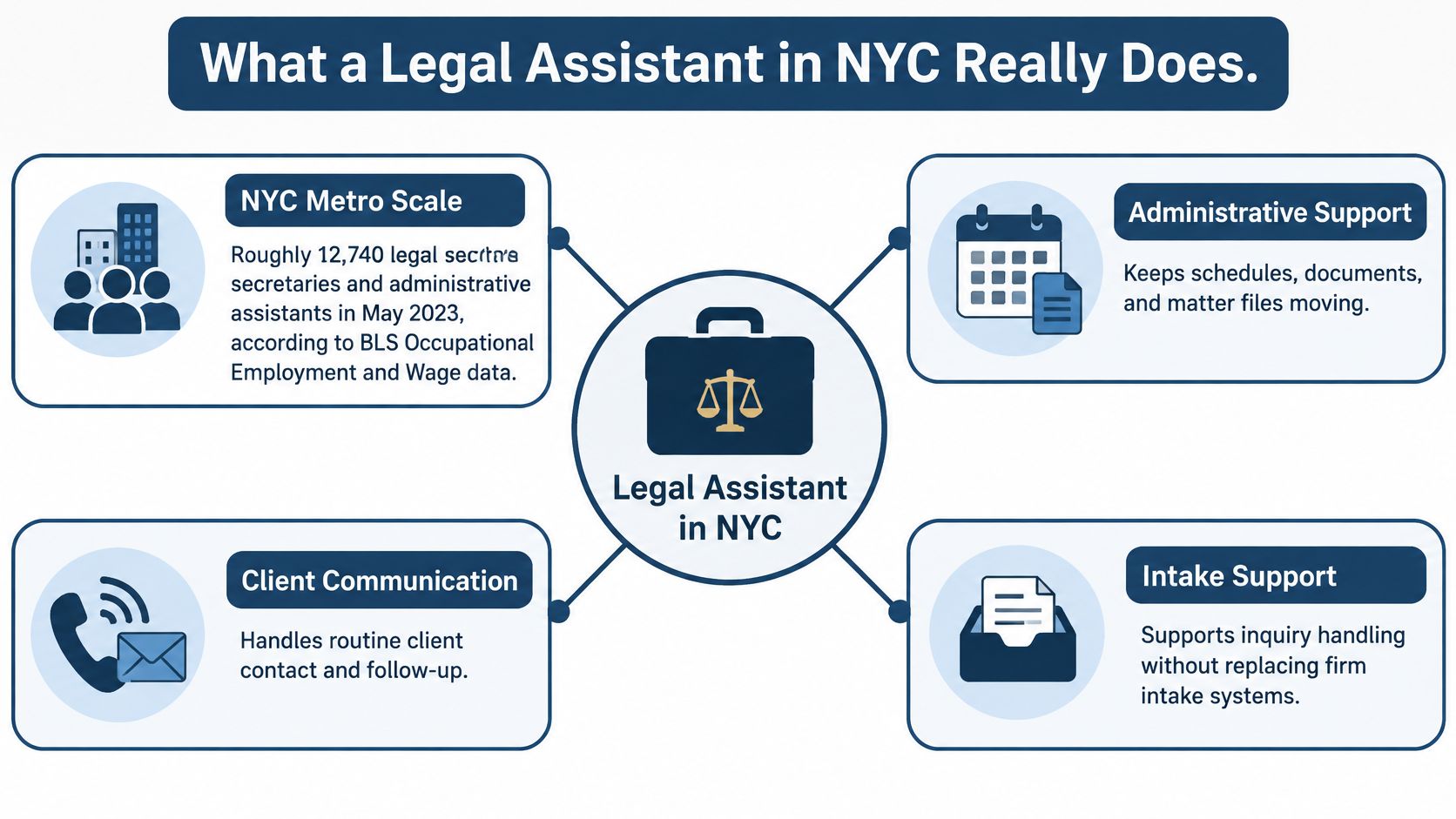
The New York-Newark-Jersey City metro area employed roughly 12,740 legal secretaries and administrative assistants in May 2022, at 1.34 jobs per 1,000 roles and a location quotient of 1.33, with mean pay of $33.88 per hour ($70,470 annually) against a national occupational mean of $56,600, and New York State accounting for 12,340 of those professionals at a mean of $68,550, according to the BLS Occupational Employment and Wage Statistics report.
That is a tight local market. Roughly one-third more concentration than the country as a whole means Manhattan, Brooklyn, and Queens firms are bidding for the same clerical capacity. A legal assistant in that market is a coverage seat with real workflow load, not a spare pair of hands between errands.
Four Work Buckets That Actually Fill the Week
Client-facing coordination takes the first block of the day. Routine inquiries, consultation bookings, status updates, and the nudge when a client never signed the retainer or uploaded an ID. In dense NYC immigrant neighborhoods, bilingual English and Spanish is often what keeps that queue moving.
Document preparation is the quiet time sink. Standard transmittal letters, exhibit packets, redaction of sensitive fields, caption checks. The attorney still reviews the submission. The assistant's job is to keep that review from opening on a mislabeled PDF.
Records and case support is where high-volume litigation practices lose days. Medical records, itemized billing statements, new matter files, lien notices, missing hospital authorizations. Some PI teams pair a dedicated assistant with AI support for busy PI teams so medical chronologies and demand packets do not stall while a person chases the next authorization.
Administrative hygiene and court prep covers the rest. Calendars across five-borough appearances, shared inboxes, CRM fields, and e-filing packages for the New York State Courts Electronic Filing (NYSCEF) system. Skip one of those and the hour you thought was covered was not.
Where the Legal Assistant Role Stops
A trained assistant may collect facts, summarize records, schedule appearances, and relay updates the attorney already approved. Legal advice, case strategy, substantive negotiation without direct attorney authority, and sign-off on whether a court filing is legally sufficient stay with the lawyer.
Treat that line as a supervision rule. Mix clerical coordination with substantive legal drafting and you hire the wrong profile, then pay for the mismatch in rework. I would scope the seat before the job post. The difference between a legal secretary and a paralegal is the practical split: who moves the file, and who is allowed to exercise legal judgment.
An assistant's job is to clear the operational runway so the lawyer spends the afternoon arguing motions and advising clients, not renaming PDF exhibits at 6:45 p.m.
Staffing Models and Cost Per Covered Hour
Firms usually start their hiring search by googling local wages, then immediately get whiplash. Public salary estimates for New York City legal assistants conflict, with one useful benchmark at roughly $28.17 per hour in Indeed New York job-posting data. That number still misses the point. It tells a managing partner what the market may pay for a legal assistant. It does not tell you what that spend buys in covered hours, response speed, or matter throughput.
Unmet demand pushes firms to expand capacity, especially when clients expect fast answers and steady case movement. The practical question is not whether a salary line looks reasonable. It is whether the coverage window matches the work that generates or protects revenue.
Staffing models for an NYC legal assistant compared
| Model | Typical annual cost | Hours covered | Supervision and QA | Best fit |
|---|---|---|---|---|
| In-house full-time employee | Salary plus payroll taxes, benefits, PTO, and equipment | Roughly 40 daytime hours, no nights or weekends | Direct manager on staff; quality depends on that manager's bandwidth | Firm with steady daytime volume and an existing operations manager |
| Part-time or local contract assistant | Around $28.17 per hour in local job postings, billed per hour worked without benefits | Limited, usually daytime and shared | Shared across clients, thin QA | Firm needing a few hours a week for filing and calendar work |
| Dedicated full-time virtual assistant | Fraction of a stateside full-time hire | 40 hours with U.S. time-zone alignment, extendable with 24/7 intake | Provider co-manages with the firm, with legal operations oversight built in | Firm that wants dedicated capacity without adding payroll and office overhead |
The table is deliberately about coverage, not just compensation. A cheap hour that lands at 10 a.m. on a Tuesday may be useless if your inquiries arrive after dinner. A pricey assistant who spends half the day waiting for instructions is also expensive. In NYC, where court calendars, client expectations, and case deadlines stack tightly, the wrong model creates rework instead of relief.
Three Criteria That Change the Verdict
Base pay is the loudest line on a budget sheet, yet three operational realities decide whether a hire relieves pressure on the firm.
Coverage hours come first. A traditional 9-to-5 employee sitting in Midtown won't solve a missed-lead problem if personal injury, immigration, or housing inquiries arrive at 7:30 p.m. on a Tuesday or noon on a Saturday. Buying daytime headcount for an after-hours bottleneck leaves the revenue leak wide open. If your firm wants intake coverage beyond the workday, price it separately from case administration.
Supervision bandwidth comes second. An in-house hire only performs as well as the person managing them. When a solo or small-firm partner is already running court appearances and client meetings, onboarding and QA slip to the bottom of the list. Attorney Assistant serves law firms nationwide across the United States, sources and vets dedicated staff, and embeds them in the firm's daily workflow. The firm directs the work, every assistant is managed by legal operations experts, and both sides co-manage operations so oversight doesn't collapse whenever a trial starts.
Training ownership stays with the firm under every model. No matter who you hire, your firm's specific templates, court preferences, Clio or Filevine folder rules, and client tone have to live in written SOPs. Attorney Assistant recommends that the firm have relevant documents and SOPs ready on the assistant's first day for firm-specific training, after initial training is provided. If your entire workflow lives inside one senior paralegal's memory, you haven't built a legal practice. You've built a single point of failure with a very impressive memory.
Running the Cost Per Covered Hour Math
Instead of comparing annual salaries in the abstract, calculate cost per covered hour: take your fully loaded annual cost and divide it by the hours covered during the windows your firm needs.
Take a simple hypothetical example. Say an NYC firm hires a daytime assistant at $70,000 in base salary for 2,000 hours a year, before payroll taxes, health insurance, paid leave, workstation hardware, and office rent. On base salary alone, that comes to $35 per covered hour for weekday daytime work. Now look at evenings, weekends, and lunch-hour overflow. That hire covers zero of those hours, which means the firm has no coverage during those windows at any price.
The same math applies to supervision. If a partner spends hours each week reviewing work that should have been checked by an operations lead, the true cost rises even when the salary stays flat. If an assistant is available during business hours but lacks clear SOPs, the firm pays for time that gets spent asking basic questions. Covered hours only count when the person can handle the work without constant reconstruction of the process.
Budget rule: Price daytime case administration and live client intake as two separate budget lines. Merging them into one 9-to-5 job description usually leaves both functions under-resourced.
Matching the Model to the Bottleneck
Different bottlenecks call for different staffing structures, and exploring structured legal staffing solutions early prevents expensive hiring detours. A firm that needs admin, intake, follow-up, and ongoing operations support should scope the work by function first. The goal is to redesign how work gets done rather than add another name to the payroll.
- Solo practitioner with steady daytime filing volume: A part-time local contractor or dedicated virtual assistant covers calendars, NYSCEF prep, and client reminders without committing to Manhattan desk overhead and full payroll taxes.
- Growing personal injury or immigration practice with heavy evening inquiries: Pair a dedicated full-time assistant for daytime file work with separate 24/7 intake coverage so evening callers speak to a trained specialist instead of a voicemail beep.
- Litigation firm buried in records and billing backlogs: Put a dedicated full-time assistant exclusively on records acquisition, lien tracking, and CRM cleanup rather than splitting a local receptionist across phones and hospital portals.
Before posting a single job ad, answer one question first: which hours of the week generate or protect your firm's revenue, and who is covering them right now?
Why Adding an Assistant Does Not Fix Intake
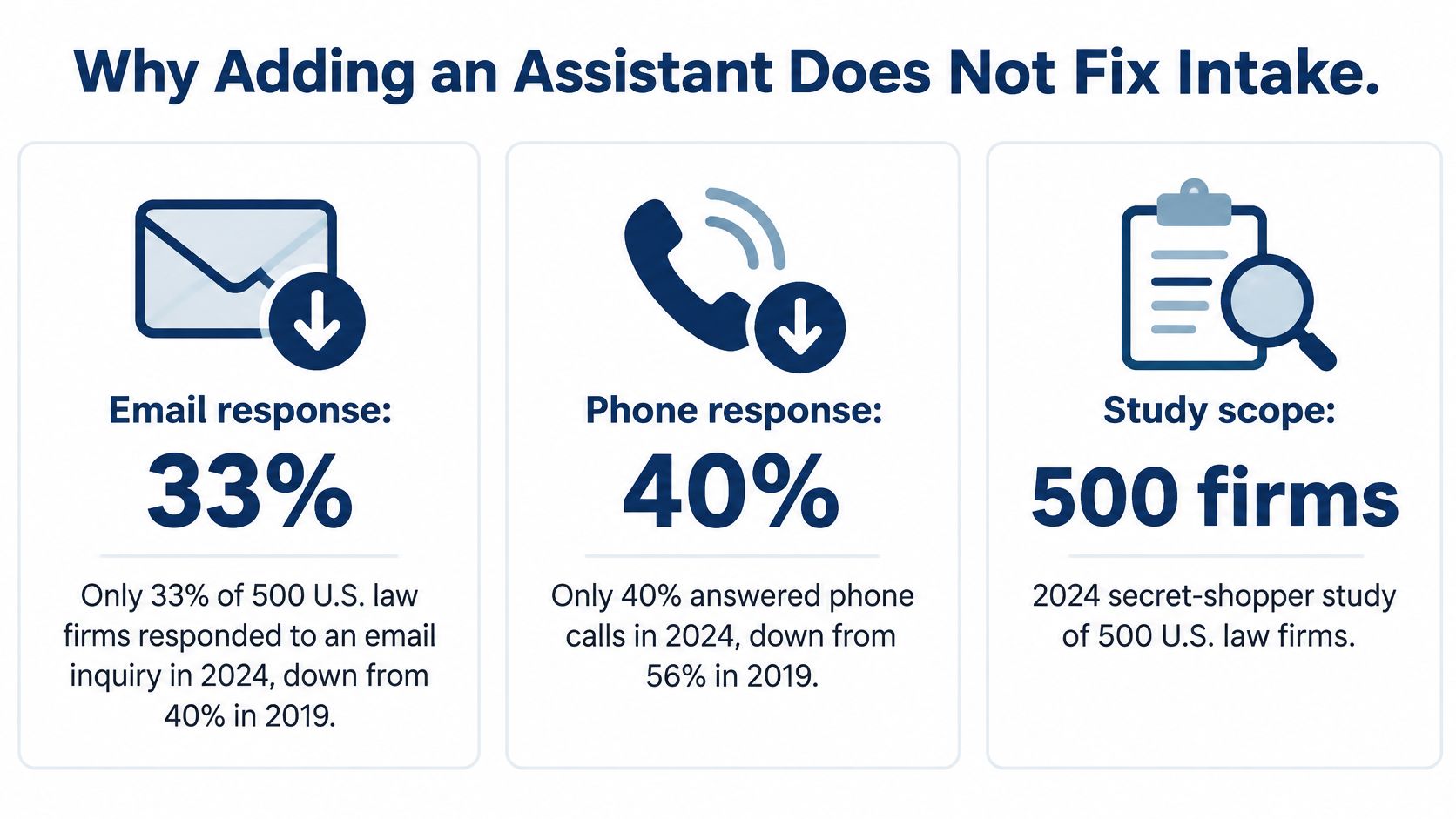
Most managing partners assume hiring an office assistant will stop leads from slipping away. The responsiveness numbers across the legal industry tell a rougher story. In a 2024 secret-shopper study of 500 U.S. law firms reported by Clio's Legal Trends press release, only 33% of firms responded to an email inquiry, down from 40% in 2019. Even among the minority that replied, just 18% gave clear next steps or pricing information, and only 2% referenced similar legal cases in their answer.
Phone performance wasn't much better. According to Clio's 2024 Legal Trends Report highlights, just 40% of law firms answered incoming phone calls in 2024, down from 56% in 2019. Even after counting firms that eventually called back, shoppers reached only 52% of firms overall, leaving 48% effectively unreachable by phone.
The graphic below sums up how steep that responsiveness drop has become across U.S. practices.
Those missed connections carry a direct reputation penalty. In coverage of the same study by the Illinois Supreme Court Commission on Professionalism, only 12% of shoppers said they were likely to recommend the firms they contacted to friends or family. Yet shoppers who spoke with a live person on the phone were more than three times as likely to recommend the firm as the average across email, phone, chatbot, and web-form channels, and nearly eight times as likely as callers who only received voicemail follow-up.
Answering the Phone Is Not Intake
A great daytime assistant sitting at a desk in Brooklyn still won't pick up a call that lands at 8:40 p.m. on a Thursday. Worse, when a busy front-desk assistant does answer between filing deadlines, the default move is scribbling a name on a sticky note and promising a callback.
Taking a message isn't intake. Technically, calling someone back four days later is follow-up, yet it isn't particularly useful follow-up when the caller already retained a competitor down the street. Your CRM can't follow up with a lead if nobody puts the lead in the CRM.
Real intake advances the matter in four concrete moves: capture the prospect's details cleanly in the system, confirm basic practice-area fit, explain the exact next step, and schedule a consultation or warm transfer while the caller is still engaged. Run your own capacity math for one typical week. Count total inquiries, separate the ones that arrive outside 9-to-5, check how many received a second outreach attempt, and compare the cost of dedicated intake coverage against the value of a single signed retainer.
The short video below walks through how modern firms rethink call handling and intake execution so prospective clients stop hitting dead ends.
Two Operating Controls Every Intake Desk Needs
Whether intake is handled in-house or through a dedicated 24/7 team, two rules keep leads from vanishing:
- A hard response-time target for every channel: Set a strict live-answer target for calls and a defined first-response clock for web forms and emails, so prospects know immediately when they'll speak with someone.
- A documented missed-lead recovery sequence: Never treat one unanswered callback as case closed. Require a second call attempt, a brief written follow-up by email or text with clear next steps, and a logged disposition in the CRM before any lead is closed out.
The Compliance Checklist Before Anyone Touches a Client File
This is the part of hiring that almost every salary blog ignores, and it's exactly where a bargain-basement assistant turns expensive. Nonlawyer support isn't just an administrative convenience; it's a supervision, confidentiality, and unauthorized-practice-of-law obligation that sits squarely on the supervising attorneys.
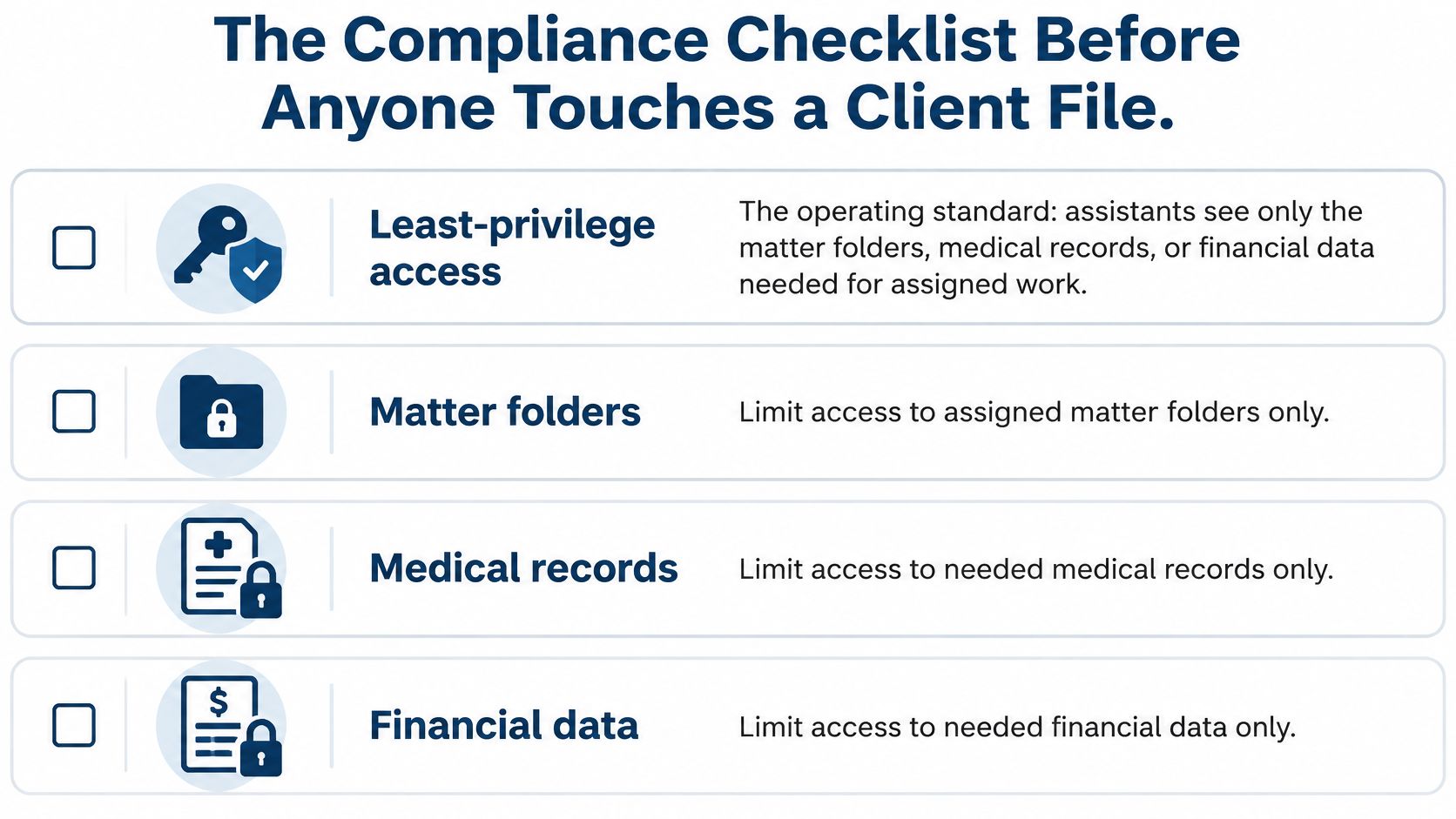
Before handing over logins or inbox permissions, lock down your file-access architecture. The checklist graphic below maps the core least-privilege boundaries every NYC legal team should enforce from day one.
Access Controls, Conflicts, and Confidentiality
Make least-privilege access your essential baseline. Assistants should only see the specific matter folders, medical records, billing statements, and financial documents required for their assigned tasks, backed by user access logs and periodic permission audits. Fast-moving teams often get tempted to hand new hires wide-open shared drive credentials to save ten minutes; that shortcut turns a minor mistake into a firm-wide confidentiality headache. Tightening law firm document management workflows up front eliminates that risk.
Build conflict-control intake directly into your forms. Intake staff should gather only the names, adverse parties, and basic incident details needed to run a conflict check before anyone discusses legal strategy or implies the firm has accepted representation.
Don't overlook lateral confidentiality risks when hiring experienced local or remote assistants. New York State Bar Association Ethics Opinion 905 explains that while a lawyer who previously learned confidential information solely as a paralegal or legal assistant isn't automatically bound by lawyer-specific imputation rules, the hiring firm must still make reasonable efforts to prevent disclosure, and formal screening from personal participation is ordinarily required whenever the person holds relevant confidential information. Pair signed nondisclosure agreements and restricted drives with a written escalation path for prior-employer or adverse-party flags.
Treating NYSCEF Like a Controlled Process
Uploading pleadings to New York courts isn't the same as attaching a flyer to an email. Under the New York State Courts NYSCEF protocol, authorized e-filers must submit documents through NYSCEF in mandatory cases, and Appellate Division rules require filed PDFs to be text-searchable, saved in archival PDF/A format, accurately paginated, and scanned at a legible resolution. Because New York guidance also sets specific correction procedures when an electronic filing contains confidential information or gets filed in error, every assistant preparing filings should run a mandatory pre-filing checklist:
- Case and party verification: Confirm the exact index number, court county, and caption parties before touching the upload screen.
- Formatting and OCR check: Verify document naming conventions, page numbering, text-searchability, and PDF/A compliance so the clerk doesn't bounce the submission.
- Exhibits and redactions: Inspect every exhibit page for legibility and scrub Social Security numbers, financial account digits, or confidential identifiers.
- Signature and authorization sign-off: Confirm attorney approval and valid signatures before submission, since attorneys retain full responsibility for substantive accuracy.
- Receipt preservation: Save the official NYSCEF confirmation notice into the matter folder immediately, creating an audit trail by matter, filer, date, and outcome.
Scripts, AI Guardrails, and Attorney Supervision
Ethics guidance on nonlawyer supervision, including the principles highlighted in professional ethics guidance on AI and nonlawyer oversight, treats nonlawyer assistants and independent contractors as personnel requiring active lawyer supervision. That same guidance stresses two modern guardrails: attorneys must assess confidentiality and security before any client information enters an AI tool and verify every AI-assisted output for accuracy, while client intake and matter prioritization require heightened oversight because screening errors directly affect who gets legal help.
Give intake and administrative staff written scripts that clearly separate administrative questions from legal advice, spell out exact triggers for warm transfers or attorney callbacks, and require logged summaries of every after-hours handoff.
Every legal decision stays with your firm's attorneys. Support staff keep the workflow moving; licensed lawyers own the judgment, the advice, and the final review.
How to Vet a Virtual Legal Support Provider
If you decide a dedicated virtual assistant or 24/7 intake team fits your budget better than another local W-2 hire, resist the urge to pick the first vendor promising cheap hourly rates. A skeptical managing partner should interview a staffing provider the same way they'd interview a senior operations hire.

Six Questions That Separate Real Operations From Generic Outsourcing
Run every candidate provider through these six checks before signing anything:
- Will my assistant be dedicated exclusively to my firm? Shared assistants juggle tickets across half a dozen law offices, which means they learn your cases in fragments and forget your partner preferences by Friday. Look for a single full-time professional assigned 40 hours a week to your matters alone.
- Who co-manages performance and call quality? Dropping a remote worker into your Slack channel and wishing you luck isn't a staffing solution. At Attorney Assistant, every assistant is managed by legal operations experts who stay involved in coaching, QA, and escalation paths alongside your internal leaders.
- Does the assistant work inside our systems or a vendor dashboard? Your team shouldn't have to copy-paste notes out of a third-party portal. Require assistants to operate directly inside your existing case management software, CRM, and restricted document drives with matter-level permissions.
- What gets trained before day one, and what must our firm supply? We handle foundational legal-support training before launch, and we recommend having your firm's core SOPs, sample documents, and workflow walkthroughs ready on day one so week one produces real work instead of endless Slack questions.
- How are coverage hours, languages, and digital channels handled? Confirm U.S. time-zone alignment for daytime staff and live English and Spanish capability if your NYC intake requires it. Some firms also evaluate tools like AI live chat for business customers from Premier Broadband for initial website engagement, yet automated chat still needs a clear handoff to trained human intake specialists who can qualify callers and get retainers signed.
- How do billing and contract commitments work? Long annual lock-ins hide weak delivery. We operate on month-to-month flexibility with no long-term commitments, because performance should be the reason a firm stays.
At Attorney Assistant, we pair dedicated full-time legal support professionals through Staffline with 24/7 live intake through Frontline, all backed by co-managed operations. The division of labor is simple: Frontline signs the case. Staffline carries it. If you want to test how your current setup holds up first, we also offer a free intake audit where a team member reaches out after you fill out the form. Use these exact six questions to evaluate any provider on your shortlist, including ones that aren't us.
Confirm the Coverage Gap Before You Hire
Before writing a job posting or signing a staffing agreement, spend one disciplined week measuring where hours and leads disappear. Five concrete steps turn guesswork into a staffing plan:
- Pull one week of raw inquiry data: Export call volume by hour of day, average email response times, total follow-up attempts per lead, and every inquiry that went dark without a logged outcome.
- Map the hours that protect revenue: Highlight the exact daytime, evening, and weekend windows where prospects contact your office and note who covers them today.
- Separate case support from intake: Put daytime records, filing prep, and administration on one budget line, and put live lead response and follow-up on another.
- Pick the right model per line: Match each budget line to the staffing table above instead of forcing one generalist hire to cover two conflicting jobs.
- Prepare your operational kit before day one: Package your SOPs, sample pleadings or correspondence, least-privilege folder permissions, and attorney escalation rules before any start date hits the calendar.
Most NYC firms find that a single week of real numbers answers half their hiring debate immediately. If you want an outside set of eyes on those gaps, you can book a call with our team or request a free intake audit to pinpoint where operational bottlenecks are leaking revenue before adding another dollar of payroll.
Attorney Assistant helps law firms nationwide replace administrative bottlenecks and missed calls with dedicated full-time legal support staff and 24/7 live intake, all co-managed by legal operations experts. Whether your NYC practice needs daytime case administration, round-the-clock lead conversion, or a clearer look at where inquiries are falling through the cracks, bring your firm's numbers and explore how we work at Attorney Assistant.
Related Articles

Client Experience Coordinator for Law Firms
See what a client experience coordinator owns in a law firm, from intake and status updates to the skills that keep matters moving.

Legal Secretary or Paralegal: Which Role Fits Your Firm
Compare legal secretary or paralegal roles by duties, pay, training and cost, then pick the one your firm needs for intake, records and attorney time.
Legal Staff Solutions: Models, Costs and How to Choose
Compare in-house, outsourced and co-managed legal staff solutions, with real cost drivers, pros and cons, and a way to choose the right model.